
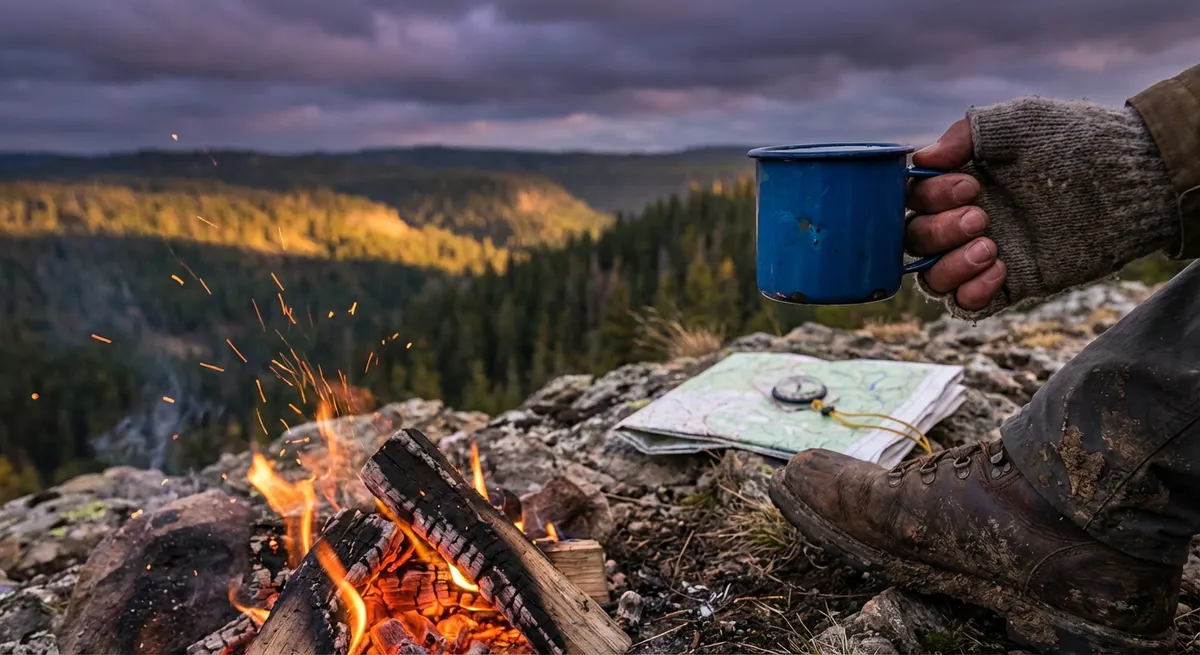
There’s a moment on every trip when comfort ends and adventure begins—when the last bar of cell signal disappears, the trail turns to rock and root, and the night sky feels close enough to touch. That’s the moment TrailNux lives for. This guide is your camp-side mentor: part practical survival briefing, part campfire story, all trail-tested wisdom. We’ll break down gear that actually matters, safety habits that keep the wild wild (and you alive), and a few real backcountry stories that prove why preparation is the gateway to real freedom out there.
Building a Basecamp That Can Take a Beating
A campsite isn’t just where you sleep—it’s your command center, your storm shelter, and your recovery zone after long miles. Treat it like a system, not just a tent tossed on flat-ish ground.
Start by reading the landscape: look for high, slightly sloped ground that will shed water if it rains, away from creek beds and dry washes that can flash flood overnight. Check above you—widowmakers (dead branches or leaning trees) are silent threats when the wind picks up. Step around: avoid pitching on fragile plants or cryptobiotic soil, which takes decades to recover.
Your shelter is only as good as its pitch. Practice at home until you can set up your tent or tarp in the dark, in wind, without swearing at your guy lines. Aim for taut lines and a low, aerodynamic profile if storms are forecast. Always carry at least four extra stakes and a short length of cord; wind, rocky ground, and soft sand have a way of humbling even the fanciest shelters.
Think of camp layout in zones: a “sleep zone” (quiet, clean, no food or scented items), a “kitchen zone” (away from your tent, downwind if possible), and a “gear zone” (organized, sheltered, and easy to access at night). This separation keeps critters and food smells away from where you sleep and makes nighttime tasks less chaotic. A small habit like hanging your headlamp from the same corner of your tent every time becomes gold when you wake to rain hammering your fly at 2 a.m.
Gear That Earns Its Weight on the Trail
Out here, everything you carry has to justify the price you pay in effort. Fancy doesn’t matter—functional does. Instead of chasing trends, focus on gear that hits three marks: durability, versatility, and repairability.
For shelter, a reliable three-season tent from brands like REI Co-op, MSR, or Big Agnes will serve most campers well, especially in unpredictable mountain conditions. If you’re weight-conscious, a trekking-pole-supported tarp or single-wall shelter can cut pack ounces, but be honest about your skill with site selection and storm management before you ditch the extra protection. Always bring a minimalist repair kit: duct tape wrapped around a trekking pole, a tent-pole splint, a sewing needle, and a bit of strong thread.
Your sleep system is your battery charger. A quality sleeping bag or quilt rated slightly colder than the lowest temperature you expect gives you margin when the wind shifts or a front blows in early. Pair it with an insulated sleeping pad; most heat is lost to the ground, not the air. A closed-cell foam pad can double as a seat, a splint, or added insulation under an inflatable pad if temps plummet unexpectedly.
For cooking, keep it simple: a canister stove like the MSR PocketRocket or Jetboil system is dependable, fast, and easy to use for beginners. If you’re going remote or in colder temps, a liquid fuel stove is more resilient but requires more skill. Always test your stove at home, know how long your fuel will last, and bring a backup fire-starting method (lighter plus waterproof matches or a small ferro rod).
Water treatment is non-negotiable. Gravity filters (like those from Platypus or Sawyer) work well for basecamp style trips, while squeeze filters, UV purifiers, or chemical treatments excel for fast-and-light missions. Redundancy matters: pair a small bottle of purification tablets with your main filter in case it freezes or fails. You’ll rarely regret the extra ounce when you’re staring at a silty stream miles from the trailhead.
Safety Habits That Turn Close Calls into Good Stories
Adventure feels wild, but surviving it is about boring consistency: the small, unglamorous habits that keep bad situations from turning deadly. Start every trip with a clear plan written down: route, dates, camps, water sources, bail-out points, and who to contact if you don’t check in. Leave this with a trusted person—not just “going camping this weekend.”
Navigation is more than a phone app. Yes, download offline maps (Gaia GPS, AllTrails, or your mapping app of choice), but back them up with a paper topographic map and a compass—and actually know how to use them. Electronics fail. Batteries die. Storms roll in and erase landmarks. The ability to orient yourself with a map and compass is a superpower that never goes out of style.
Learn the basics of wilderness first aid: how to stop bleeding, splint a limb with trekking poles, recognize dehydration and hypothermia, and treat blisters before they become open wounds. A compact, well-stocked first aid kit is essential, but it’s your knowledge that unlocks its power. Courses from organizations like NOLS or the Red Cross turn “I hope nothing goes wrong” into “I can handle it if it does.”
Weather awareness is your early-warning system. Before your trip, study the forecast from multiple sources, understand typical patterns in your region, and learn to read the sky: building cumulus clouds, sudden temperature drops, and shifting wind can all signal incoming storms. In exposed areas or high mountains, be ready to retreat below treeline when thunderstorms roll in—lightning doesn’t negotiate.
Finally, respect wildlife. Store food properly using bear canisters, bear hangs, or metal lockers where available. Never leave food or scented items in your tent. Know what large animals inhabit your area and the recommended behavior for encounters—standing your ground with black bears is not the same as reactively dealing with grizzlies or moose. Giving animals distance isn’t just ethical; it’s smart self-preservation.
Trail Stories from the Edge of the Campfire Glow
Some lessons only stick when they’re burned into memory by experience. These stories—from real backcountry scenarios—carry the kind of wisdom that doesn’t show up in gear catalogs.
On a late-season trip in the Rockies, a pair of friends pushed their luck with daylight, convinced the campsite on their map “had to be just around the next bend.” When they finally arrived, darkness was thick in the forest and the temperature was plummeting. Instead of rushing to set up camp in frustration, they took five deliberate minutes to assign tasks: one person set the tent, the other fetched and filtered water and unpacked headlamps and layers. Because they’d practiced their setup, they had shelter and hot food ready before the cold really bit. The trip could’ve started with numb fingers and frayed nerves; instead, it became a story about teamwork and calm under pressure.
Another time, a group on a desert rim woke to the sound of wind slamming into their tents like a freight train. Gusts had shifted 90 degrees overnight, threatening to snap poles and send gear sailing off the plateau. But they’d anchored extra guy lines and weighted stakes with rocks, anticipating that canyon winds rarely blow from just one direction. When another party nearby watched their unanchored tent cartwheel into the darkness, the difference wasn’t luck—it was ten minutes of preventative work the evening before.
Then there’s the quiet success story: a solo camper who woke at 1 a.m. to the unmistakable rustle of something large near the “kitchen zone.” Heart pounding, she realized she’d done the boring work right: all scented items sealed and stashed properly, cook area far from the tent, no food forgotten in pockets or boot tops. The animal sniffed, moved on, and she drifted back to sleep. No spotlight, no social media heroics—just the satisfying knowledge that her habits worked exactly as they were supposed to.
These stories don’t end with rescues or headlines, and that’s the point. The best camping tales are often about how nothing went catastrophically wrong because someone made small, smart choices when it still felt like “just in case.”
Keeping the Wild Wild: Low-Impact Camping That Still Feels Epic
Real adventure doesn’t have to leave scars. The more time you spend out there, the more obvious it becomes: our presence can either slowly erase the places we love or help keep them wild for the next crew of dreamers.
Start with the basics of Leave No Trace principles. Plan ahead so you’re not forced into bad decisions—like camping on fragile vegetation because you arrived too late to find a durable site. Stick to established trails and campsites where they exist; that “perfect” patch of untouched meadow is perfect precisely because people haven’t trampled it yet. Durable surfaces like rock, gravel, dry grass, and snow make better homes for your tent than living plants and delicate soils.
Waste management is where good intentions often fail. In areas without toilets, know how to dig and use a cathole correctly: at least 6–8 inches deep, 200 feet from water, trails, and camps. Pack out all toilet paper in a designated bag (yes, all of it). In heavily used or sensitive areas, consider using wag bags or pack-out systems if required. As for trash, the standard is simple: everything you brought in leaves with you—yes, even that tiny piece of micro-trash from your snack wrapper.
Campfires can be magical, but they’re increasingly a privilege, not a guarantee. Learn and respect local regulations, especially in fire-prone regions. Where fires are allowed, use existing fire rings, keep fires small, and burn only downed, dead wood that can be broken by hand. Extinguish with water, not just dirt, and stir the ashes with a stick until everything is cold to the touch. Better yet, learn to make evenings feel just as special with a camp stove, lantern, and a sky full of stars.
Low-impact camping isn’t about tamping down adventure; it’s about making sure the feeling of wildness remains for the next person who steps into that valley or forest. There’s a quiet pride in leaving a camp so immaculate that someone passing by the next day would never know you’d been there at all.
Conclusion
Camping is more than a checklist of gear or a well-posed tent photo—it’s a craft. Every night out is a chance to sharpen your instincts, refine your systems, and earn the kind of confidence that only comes from meeting the unknown halfway. When your camp is dialed, your safety habits are second nature, and your footprint is light, something shifts: fear gives way to respect, discomfort becomes challenge, and the wild stops feeling like an enemy to be endured and starts feeling like a partner in the journey.
Out there, under cold stars and among dark tree lines, you’re not just surviving—you’re learning to belong. Pack smart, move humbly, stay curious, and let the trail teach you. The next great story you tell around a fire might be your own.
Sources
- [Leave No Trace Center for Outdoor Ethics – Seven Principles](https://lnt.org/why/7-principles/) - Core guidelines for minimizing impact while camping and hiking
- [National Park Service – Camping Safety Tips](https://www.nps.gov/articles/camping-safety.htm) - Official advice on staying safe in U.S. national parks
- [REI Co-op – Expert Advice: How to Choose a Campsite](https://www.rei.com/learn/expert-advice/campsite.html) - Practical guidance on site selection and camp setup
- [Centers for Disease Control and Prevention – Safe Drinking Water in the Backcountry](https://www.cdc.gov/healthywater/drinking/travel/backcountry_water_treatment.html) - Evidence-based information on water treatment methods
- [NOLS – Wilderness First Aid Basics](https://nols.edu/en/resources/blog/wilderness-first-aid-basics/) - Overview of essential first aid concepts for backcountry travel